


Knowledge Base
 Literature
 Product Information
 Expert Tips
 Videos
Comparison of Iminodiacetic acid (IDA) and Nitriloacetic acid (NTA) as IMAC Media
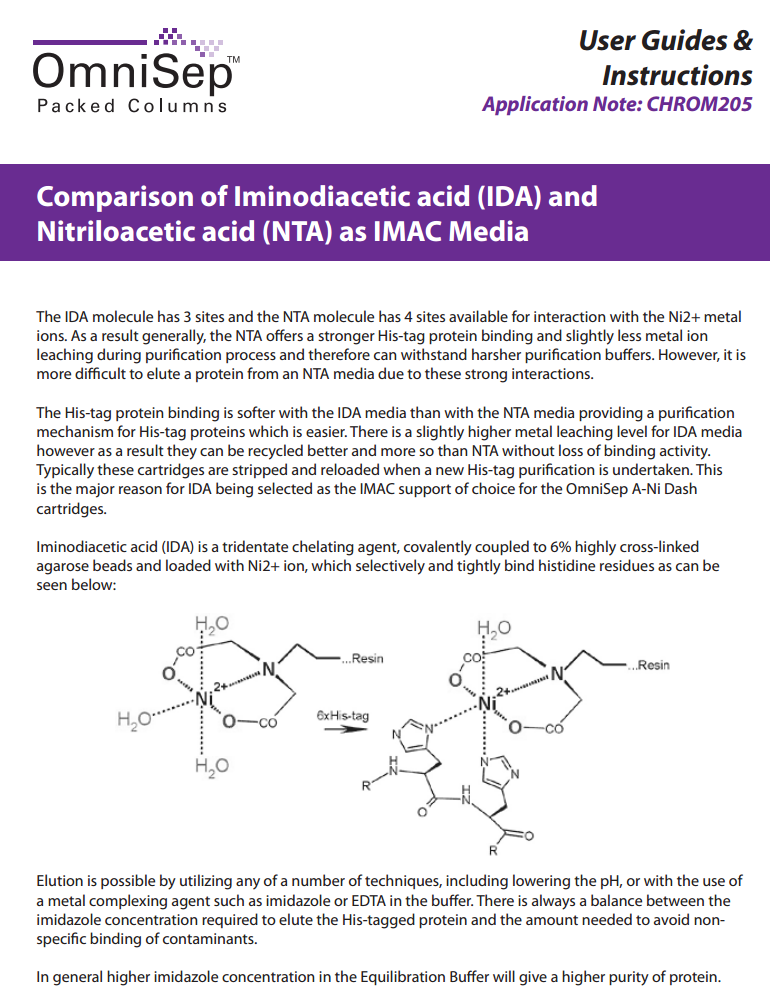
The IDA molecule has 3 sites and the NTA molecule has 4 sites available for interaction with the Ni2+ metal ions. As a result generally, the NTA offers a stronger His-tag protein binding and slightly less metal ion leaching during purification process and therefore can withstand harsher purification buffers. However, it is more difficult to elute a protein from an NTA media due to these strong interactions. The His-tag protein binding is softer with the IDA media than with the NTA media providing a purification mechanism for His-tag proteins which is easier. There is a slightly higher metal leaching level for IDA media however as a result they can be recycled better and more so than NTA without loss of binding activity. Typically these cartridges are stripped and reloaded when a new His-tag purification is undertaken. This is the major reason for IDA being selected as the IMAC support of choice for the OmniSep A-Ni Dash cartridges. Iminodiacetic acid (IDA) is a tridentate chelating agent, covalently coupled to 6% highly cross-linked agarose beads and loaded with Ni2+ ion, which selectively and tightly bind histidine residues as can be seen below:


- Widely used system – so no surprises
- Simple purification procedure under either native or denaturing conditions
- His-tag does not affect bioactivity of protein
- pH stability of 3 – 13 (short term 2 – 14)
- Binding capacity of up to 10 mg 6xHis-tagged protein per ml
- Direct purification from crude bacterial lysates
- Best purity of protein
- Resin can be regenerated for multiple uses
- Extremely cost effective
- Production of chemical intermediates
- Production of vaccines and adjuvants
- Production of antigen for the generation of antibodies
- Production of antigens for in vitro diagnosis
- Production of research reagents
0.1 MB
Date posted: 1st Oct 2013 , 10:15am