

Knowledge Base
 Literature
 Product Information
 Expert Tips
 Videos
Inlet Liner Geometry and the Impact on GC Sample Analysis of a PAH Mix
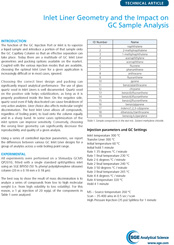
 The function of the GC Injection Port or Inlet is to vaporize a liquid sample and introduce a portion of that sample onto the GC Capillary Column so that an effective separation can take place. Today there are a multitude of GC Inlet Liner geometries and packing options available on the market. Coupled with the various injection modes that are available, choosing the optimal Inlet Liner for a given application is increasingly difficult or in most cases, ignored. Choosing the correct liner design and packing can significantly impact analytical performance. For example, the use of glass quartz wool in Inlet Liners is well documented. On the positive side, it helps volatilization, as long as it is properly positioned inside the liner. On the negative side, quartz wool even if fully deactivated can cause breakdown of very active analytes. Liner choice also affects molecular weight discrimination. The best Inlet Liner allows all compounds, regardless of boiling point, to load onto the column equally and in a sharp band. In some cases optimization of the inlet system can improve sensitivity. Conversely, choosing the wrong liner geometry can significantly decrease the reproducibility and quality of a given analysis. Using a series of controlled injection parameters, SGE report the differences between various GC Inlet Liner designs for a group of analytes across a wide boiling point range.
Experimental parameters 
All experiments were performed on a Shimadzu GCMS QP2010, fitted with a single standard split/splitless inlet using an SGE BPX50 (50 % phenyl polysilphenylene siloxane) column (20 m x 0.18 mm x 0.18 ?m). The best way to show the result of mass discrimination is to analyze a series of compounds from low to high molecular weight (i.e. from high volatility to low volatility). For this reason, a 1 ?L injection of 20 ng/?L of the components in Table 1 were analyzed.
Conclusions - Optimal Geometry
The geometry of the lnlet Liner impacts the analytical performance and outcome. Four geometries delivered good recoveries of the PAH’s; the optimal geometries based on recovery of the high boiling point PAH’s were those liners where the wool was in a fixed position and the sample was injected into the wool regardless of presence of a taper. The bottom taper quartz wool at fixed position is ideally suited to evaluate a large boiling point range of analytes, without compromising the resolution. For those analyses where very sensitive or active samples are being evaluated, and the presence of wool can adversely affect the result, the direct injection tapered liner yields excellent recoveries. 
Download the full version of this article as a PDF below.